# GLNet
**Repository Path**: mirrors_VITA-Group/GLNet
## Basic Information
- **Project Name**: GLNet
- **Description**: [CVPR 2019, Oral] "Collaborative Global-Local Networks for Memory-Efficient Segmentation of Ultra-High Resolution Images" by Wuyang Chen*, Ziyu Jiang*, Zhangyang Wang, Kexin Cui, and Xiaoning Qian
- **Primary Language**: Unknown
- **License**: MIT
- **Default Branch**: master
- **Homepage**: None
- **GVP Project**: No
## Statistics
- **Stars**: 0
- **Forks**: 0
- **Created**: 2022-01-11
- **Last Updated**: 2026-03-30
## Categories & Tags
**Categories**: Uncategorized
**Tags**: None
## README
# GLNet for Memory-Efficient Segmentation of Ultra-High Resolution Images
[](https://lgtm.com/projects/g/chenwydj/ultra_high_resolution_segmentation/context:python) [](https://opensource.org/licenses/MIT)
Collaborative Global-Local Networks for Memory-Efficient Segmentation of Ultra-High Resolution Images
Wuyang Chen*, Ziyu Jiang*, Zhangyang Wang, Kexin Cui, and Xiaoning Qian
In CVPR 2019 (Oral). [[Youtube](https://www.youtube.com/watch?v=am1GiItQI88)]
## Overview
Segmentation of ultra-high resolution images is increasingly demanded in a wide range of applications (e.g. urban planning), yet poses significant challenges for algorithm efficiency, in particular considering the (GPU) memory limits.
We propose collaborative **Global-Local Networks (GLNet)** to effectively preserve both global and local information in a highly memory-efficient manner.
* **Memory-efficient**: **training w. only one 1080Ti** and **inference w. less than 2GB GPU memory**, for ultra-high resolution images of up to 30M pixels.
* **High-quality**: GLNet outperforms existing segmentation models on ultra-high resolution images.
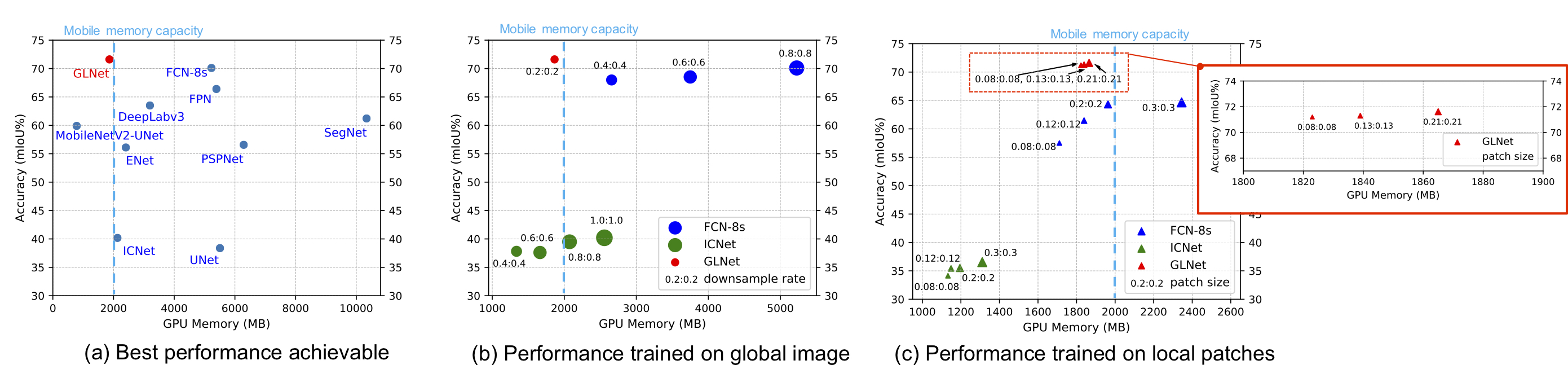 Inference memory v.s. mIoU on the DeepGlobe dataset.
GLNet (red dots) integrates both global and local information in a compact way, contributing to a well-balanced trade-off between accuracy and memory usage.
Inference memory v.s. mIoU on the DeepGlobe dataset.
GLNet (red dots) integrates both global and local information in a compact way, contributing to a well-balanced trade-off between accuracy and memory usage.
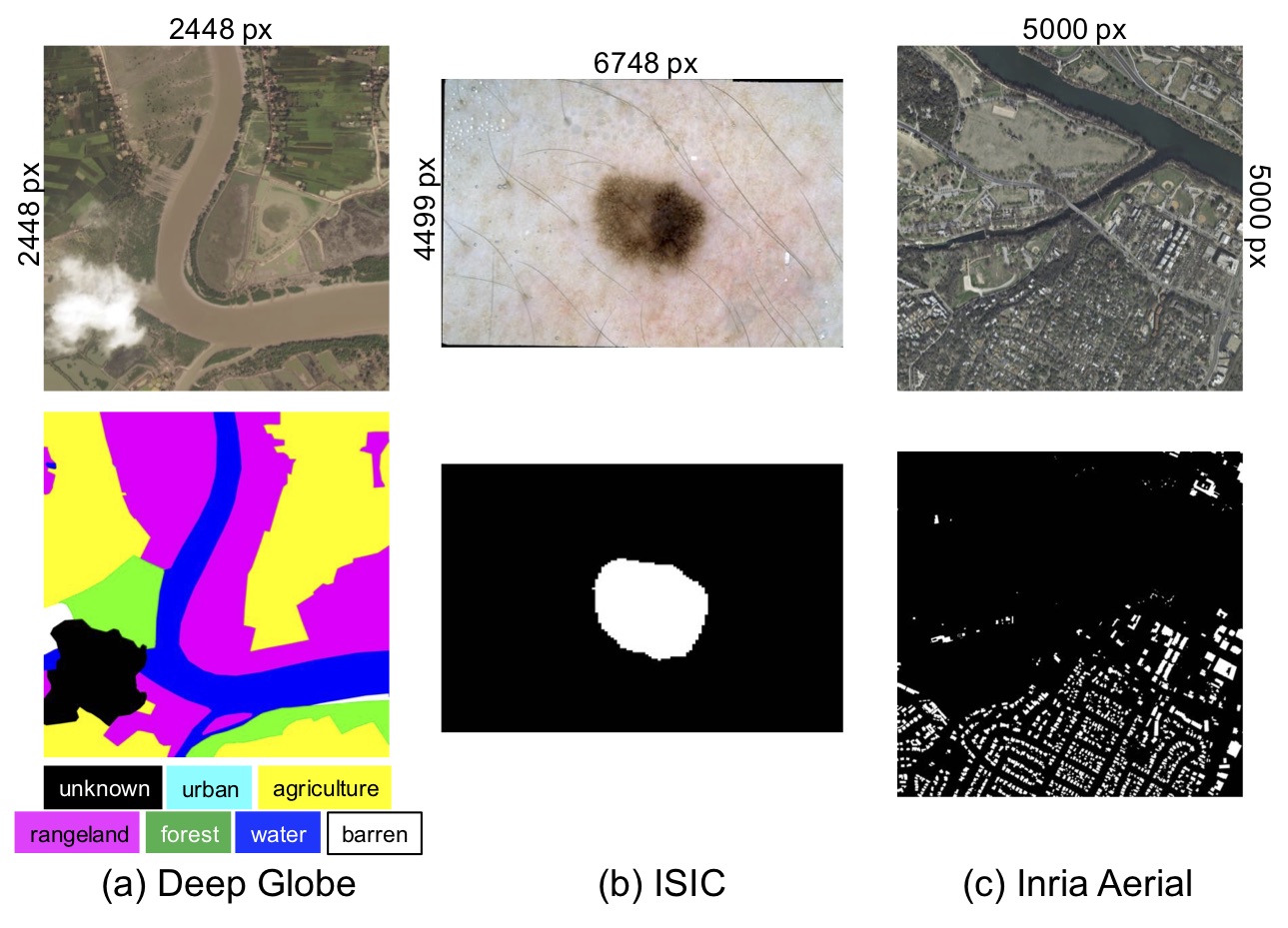 Ultra-high resolution Datasets: DeepGlobe, ISIC, Inria Aerial
## Methods
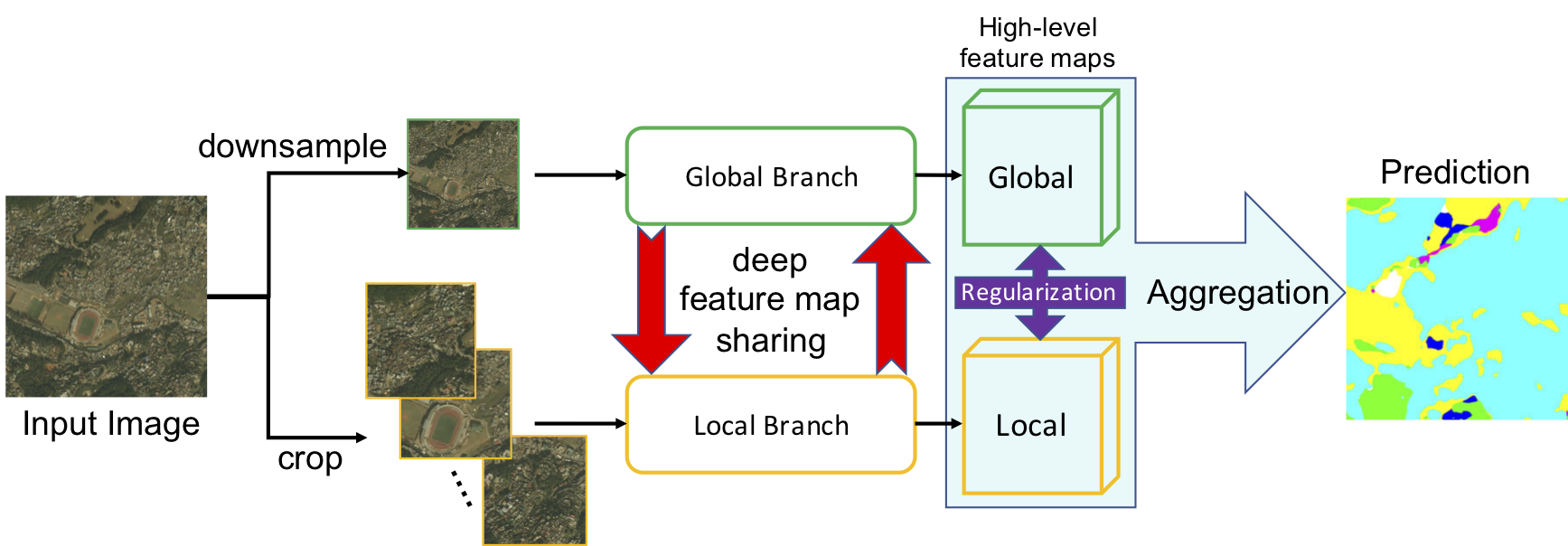 GLNet: the global and local branch takes downsampled and cropped images, respectively. Deep feature map sharing and feature map regularization enforce our global-local collaboration. The final segmentation is generated by aggregating high-level feature maps from two branches.
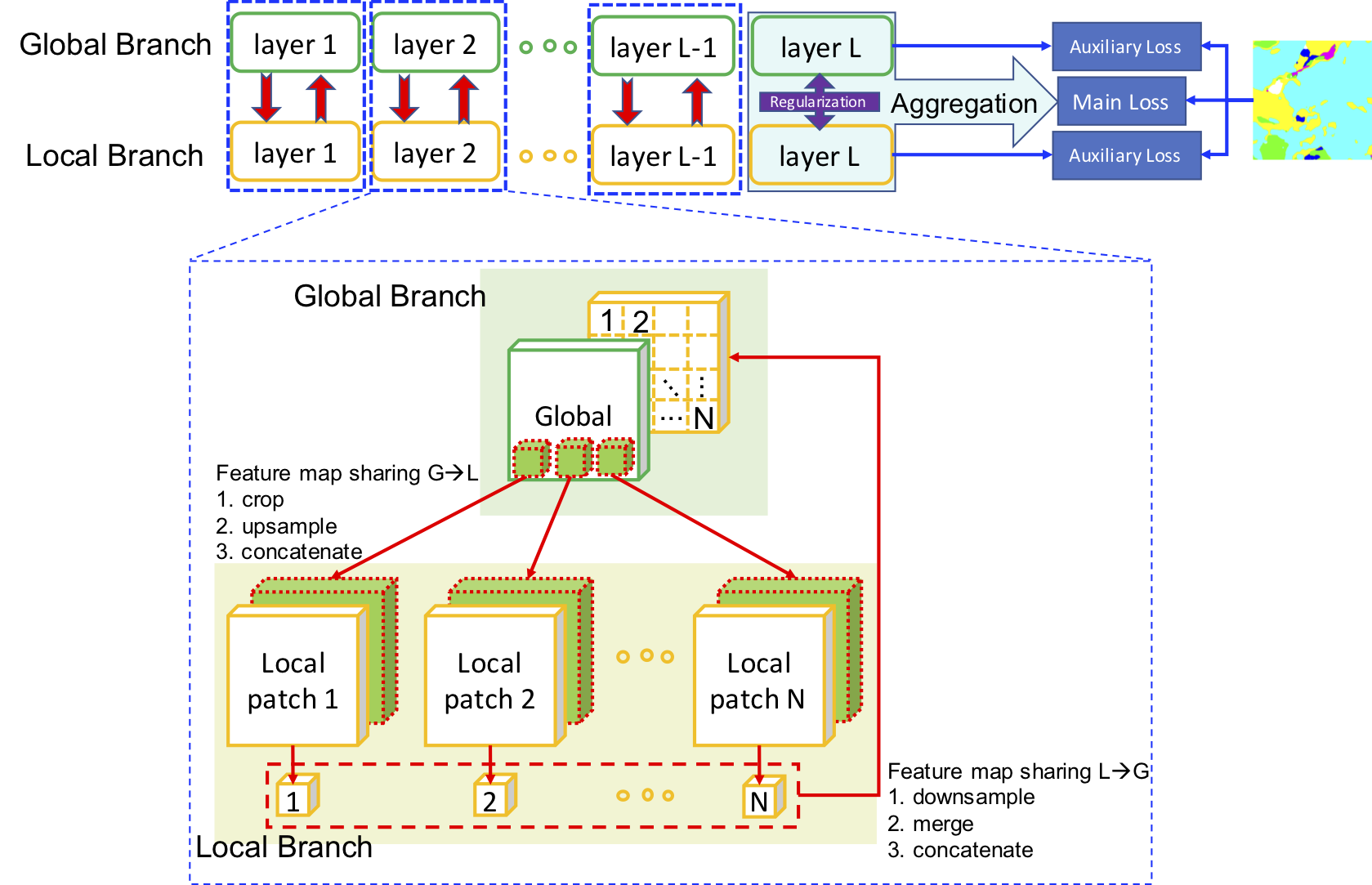 Deep feature map sharing: at each layer, feature maps with global context and ones with local fine structures are bidirectionally brought together, contributing to a complete patch-based deep global-local collaboration.
## Training
Current this code base works for Python version >= 3.5.
Please install the dependencies: `pip install -r requirements.txt`
First, you could register and download the Deep Globe "Land Cover Classification" dataset here:
https://competitions.codalab.org/competitions/18468
Then please sequentially finish the following steps:
1. `./train_deep_globe_global.sh`
2. `./train_deep_globe_global2local.sh`
3. `./train_deep_globe_local2global.sh`
The above jobs complete the following tasks:
* create folder "saved_models" and "runs" to store the model checkpoints and logging files (you could configure the bash scrips to use your own paths).
* step 1 and 2 prepare the trained models for step 2 and 3, respectively. You could use your own names to save the model checkpoints, but this requires to update values of the flag `path_g` and `path_g2l`.
## Evaluation
1. Please download the pre-trained models for the Deep Globe dataset and put them into folder "saved_models":
* [fpn_deepglobe_global.pth](https://drive.google.com/file/d/1xUJoNEzj5LeclH9tHXZ2VsEI9LpC77kQ/view?usp=sharing)
* [fpn_deepglobe_global2local.pth](https://drive.google.com/file/d/1_lCzi2KIygcrRcvBJ31G3cBwAMibn_AS/view?usp=sharing)
* [fpn_deepglobe_local2global.pth](https://drive.google.com/file/d/198EcAO7VN8Ujn4N4FBg3sRgb8R_UKhYv/view?usp=sharing)
2. Download (see above "Training" section) and prepare the Deep Globe dataset according to the train.txt and crossvali.txt: put the image and label files into folder "train" and folder "crossvali"
3. Run script `./eval_deep_globe.sh`
## Citation
If you use this code for your research, please cite our paper.
```
@inproceedings{chen2019GLNET,
title={Collaborative Global-Local Networks for Memory-Efficient Segmentation of Ultra-High Resolution Images},
author={Chen, Wuyang and Jiang, Ziyu and Wang, Zhangyang and Cui, Kexin and Qian, Xiaoning},
booktitle={Proceedings of the IEEE Conference on Computer Vision and Pattern Recognition},
year={2019}
}
```
## Acknowledgement
We thank Prof. Andrew Jiang and Junru Wu for helping experiments.