# Monkey
**Repository Path**: han-cheese/Monkey
## Basic Information
- **Project Name**: Monkey
- **Description**: No description available
- **Primary Language**: Unknown
- **License**: MIT
- **Default Branch**: main
- **Homepage**: None
- **GVP Project**: No
## Statistics
- **Stars**: 0
- **Forks**: 0
- **Created**: 2026-01-27
- **Last Updated**: 2026-01-27
## Categories & Tags
**Categories**: Uncategorized
**Tags**: None
## README

Please give us a star ⭐ for the latest update.
[](https://arxiv.org/abs/2311.06607)
[](https://github.com/Yuliang-Liu/Monkey/blob/main/LICENSE)
[](https://github.com/Yuliang-Liu/Monkey/issues?q=is%3Aopen+is%3Aissue)
[](https://github.com/Yuliang-Liu/Monkey/issues?q=is%3Aissue+is%3Aclosed)
> [**[CVPR 2024] Monkey: Image Resolution and Text Label Are Important Things for Large Multi-modal Models**](https://arxiv.org/abs/2311.06607)
> Zhang Li, Biao Yang, Qiang Liu, Zhiyin Ma, Shuo Zhang, Jingxu Yang, Yabo Sun, Yuliang Liu, Xiang Bai
[](https://arxiv.org/abs/2311.06607)
[](README.md)
[](http://huggingface.co/datasets/echo840/Detailed_Caption)
[](http://huggingface.co/echo840/Monkey)
[](https://www.wisemodel.cn/models/HUST-VLRLab/Monkey/)
> [**[TPAMI 2026] TextMonkey: An OCR-Free Large Multimodal Model for Understanding Document**](https://arxiv.org/abs/2403.04473)
> Yuliang Liu, Biao Yang, Qiang Liu, Zhang Li, Zhiyin Ma, Shuo Zhang, Xiang Bai
[](https://arxiv.org/abs/2403.04473)
[](monkey_model/text_monkey/README.md)
[](https://huggingface.co/datasets/MelosY/TextMonkey_Data/tree/main)
[](https://www.modelscope.cn/models/lvskiller/TextMonkey)
> [**[NeurIPS 2024] MoE Jetpack: From Dense Checkpoints to Adaptive Mixture of Experts for Vision Tasks**](https://arxiv.org/abs/2406.04801)
> Xingkui Zhu, Yiran Guan, Dingkang Liang, Yuchao Chen, Yuliang Liu, Xiang Bai
[](https://arxiv.org/abs/2406.04801)
[](https://github.com/Adlith/MoE-Jetpack?tab=readme-ov-file)
> [**[ICLR 2025] Mini-Monkey: Multi-Scale Adaptive Cropping for Multimodal Large Language Models**](https://arxiv.org/pdf/2408.02034)
> Mingxin Huang, Yuliang Liu, Dingkang Liang, Lianwen Jin, Xiang Bai
[](https://arxiv.org/abs/2408.02034)
[](project/mini_monkey)
[](https://www.wisemodel.cn/models/HUST-VLRLab/Mini-Monkey)
[](https://huggingface.co/mx262/MiniMokney)
> [**[IJCV 2025] Liquid: Language Models are Scalable and Unified Multi-modal Generators**](https://arxiv.org/pdf/2408.02034)
> Junfeng Wu, Yi Jiang, Chuofan Ma, Yuliang Liu, Hengshuang Zhao, Zehuan Yuan, Song Bai, Xiang Bai
[](https://arxiv.org/abs/2412.04332)
[](https://github.com/FoundationVision/Liquid)
> [**[ICCV 2025] LIRA: Inferring Segmentation in Large Multi-modal Models with Local Interleaved Region Assistance**](https://arxiv.org/abs/2507.06272)
> Zhang Li, Biao Yang, Qiang Liu, Shuo Zhang, Zhiyin Ma, Shuo Zhang, Liang Yin, Linger Deng, Yabo Sun, Yuliang Liu, Xiang Bai
[](https://arxiv.org/abs/2507.06272)
[](https://github.com/echo840/LIRA)
> [**MonkeyOCR: Document Parsing with a Structure-Recognition-Relation Triplet Paradigm**](https://arxiv.org/abs/2506.05218)
> Zhang Li, Yuliang Liu, Qiang Liu, Zhiyin Ma, Ziyang Zhang, Shuo Zhang, Zidun Guo, Jiarui Zhang, Xinyu Wang, Xiang Bai
[](https://arxiv.org/abs/2506.05218)
[](https://github.com/Yuliang-Liu/MonkeyOCR)
[](https://huggingface.co/echo840/MonkeyOCR)
[](http://vlrlabmonkey.xyz:7685/)
>
>
## News
* ```2025.6.6 ``` 🚀 [MonkeyOCR](https://github.com/Yuliang-Liu/MonkeyOCR): Try our document parsing model — Accurate, Fast, and Easy to Use.
* ```2025.4.17 ``` 🚀 [Liquid](https://arxiv.org/abs/2412.04332): Bridging Text‑to‑Image and Image‑to‑Text in One Framework.
* ```2024.8.6 ``` 🚀 We release the paper [Mini-Monkey](https://arxiv.org/abs/2408.02034).
* ```2024.4.5 ``` 🚀 Monkey is nominated as CVPR 2024 Highlight paper.
* ```2024.3.8 ``` 🚀 We release the paper [TextMonkey](https://arxiv.org/abs/2403.04473).
* ```2024.1.3 ``` 🚀 Release the basic data generation pipeline. [Data Generation](./data_generation)
* ```2023.11.06``` 🚀 We release the paper [Monkey](https://arxiv.org/abs/2311.06607).
## 🐳 Model Zoo
Monkey-Chat
| Model|Language Model|Transformers(HF) |MMBench-Test|CCBench|MME|SeedBench_IMG|MathVista-MiniTest|HallusionBench-Avg|AI2D Test|OCRBench|
|---------------|---------|-----------------------------------------|---|---|---|---|---|---|---|---|
|Monkey-Chat|Qwev-7B|[🤗echo840/Monkey-Chat](https://huggingface.co/echo840/Monkey-Chat)|72.4|48|1887.4|68.9|34.8|39.3|68.5|534|
|Mini-Monkey|internlm2-chat-1_8b|[Mini-Monkey](https://huggingface.co/mx262/MiniMokney)|---|75.5|1881.9|71.3|47.3|38.7|74.7|802|
## Environment
```python
conda create -n monkey python=3.9
conda activate monkey
git clone https://github.com/Yuliang-Liu/Monkey.git
cd ./Monkey
pip install -r requirements.txt
```
You can download the corresponding version of flash_attention from https://github.com/Dao-AILab/flash-attention/releases/ and use the following code to install:
```python
pip install flash_attn-2.3.5+cu117torch2.0cxx11abiFALSE-cp39-cp39-linux_x86_64.whl --no-build-isolation
```
## Train
We also offer Monkey's model definition and training code, which you can explore above. You can execute the training code through executing `finetune_ds_debug.sh` for Monkey and `finetune_textmonkey.sh` for TextMonkey.
The json file used for Monkey training can be downloaded at [Link](https://drive.google.com/file/d/18z_uQTe8Jq61V5rgHtxOt85uKBodbvw1/view?usp=sharing).
## Inference
Run the inference code for Monkey and Monkey-Chat:
```
python ./inference.py --model_path MODEL_PATH --image_path IMAGE_PATH --question "YOUR_QUESTION"
```
## Demo
Demo is fast and easy to use. Simply uploading an image from your desktop or phone, or capture one directly.
[Demo_chat](http://vlrlab-monkey.xyz:7681) is also launched as an upgraded version of the original demo to deliver an enhanced interactive experience.
We also provide the source code and the model weight for the original demo, allowing you to customize certain parameters for a more unique experience. The specific operations are as follows:
1. Make sure you have configured the [environment](#environment).
2. You can choose to use the demo offline or online:
- **Offline:**
- Download the [Model Weight](http://huggingface.co/echo840/Monkey).
- Modify `DEFAULT_CKPT_PATH="pathto/Monkey"` in the `demo.py` file to your model weight path.
- Run the demo using the following command:
```
python demo.py
```
- **Online:**
- Run the demo and download model weights online with the following command:
```
python demo.py -c echo840/Monkey
```
For TextMonkey you can download the model weight from [Model Weight](https://www.modelscope.cn/models/lvskiller/TextMonkey) and run the demo code:
``` python
python demo_textmonkey.py -c model_path
```
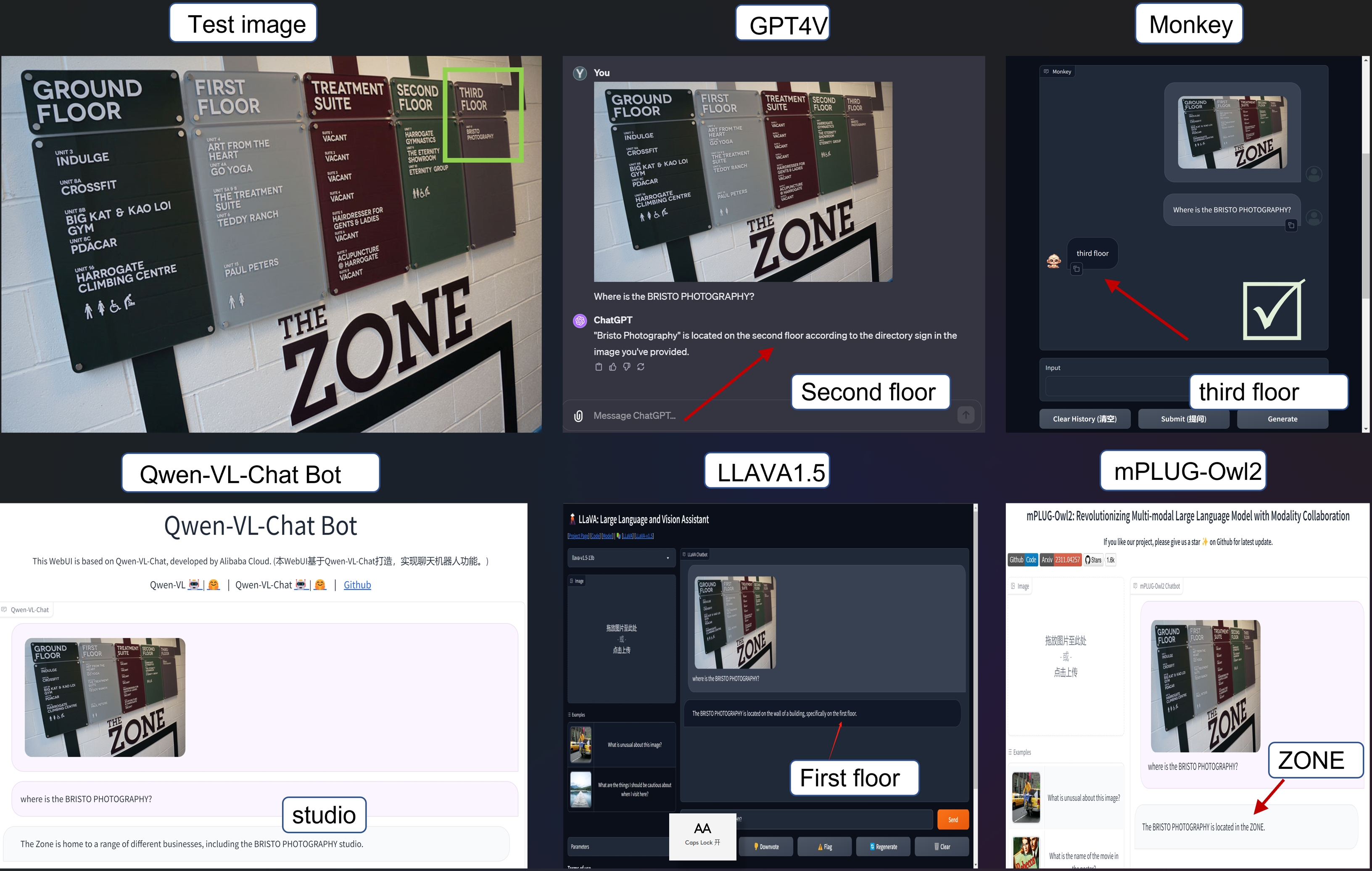
Before 14/11/2023, we have observed that for some random pictures Monkey can achieve more accurate results than GPT4V.
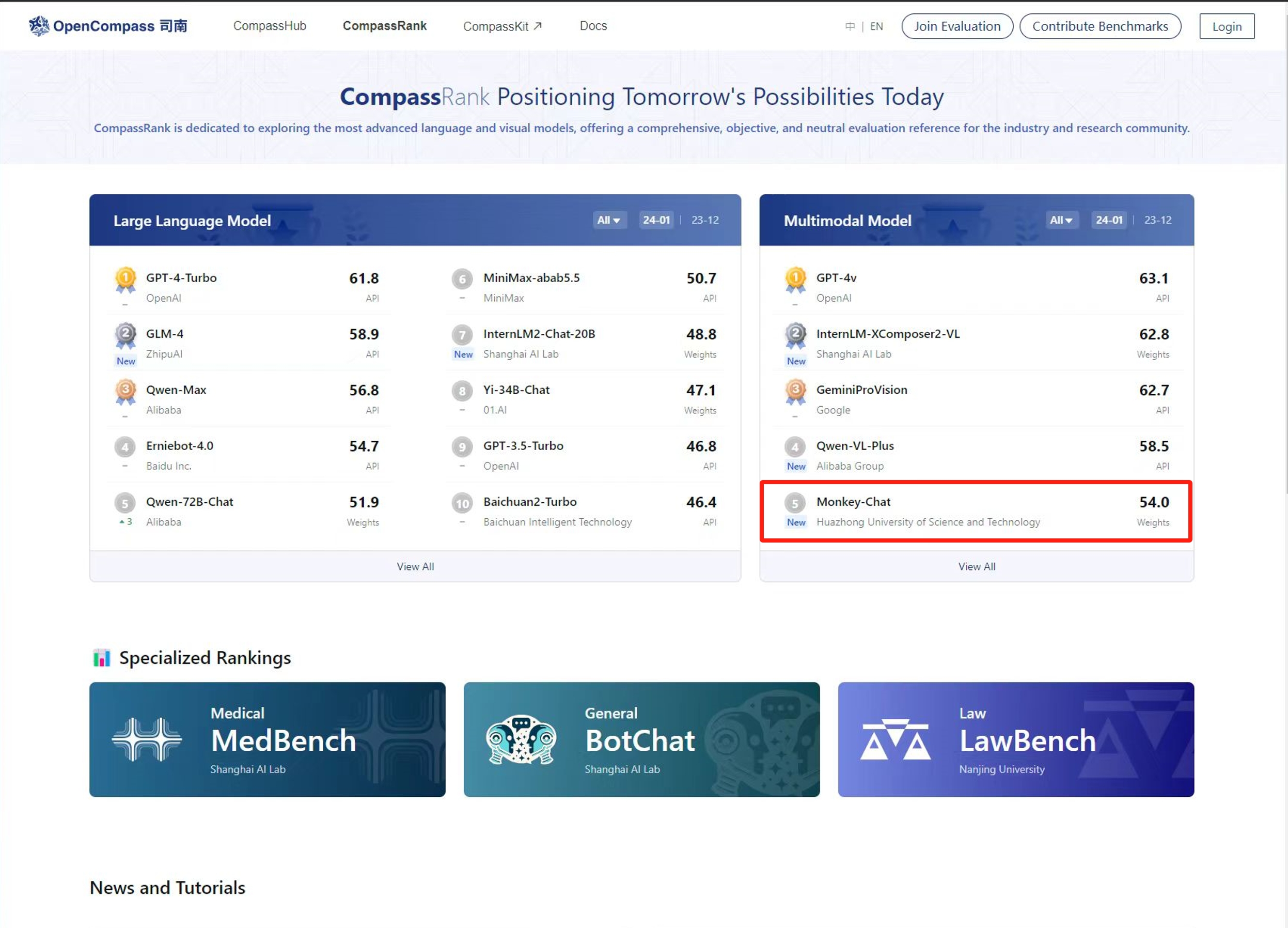
Before 31/1/2024, Monkey-chat achieved the fifth rank in the Multimodal Model category on [OpenCompass](https://opencompass.org.cn/home).
## Dataset
You can download the training and testing data used by monkey from [Monkey_Data](https://huggingface.co/datasets/echo840/Monkey_Data).
The json file used for Monkey training can be downloaded at [Link](https://drive.google.com/file/d/18z_uQTe8Jq61V5rgHtxOt85uKBodbvw1/view?usp=sharing).
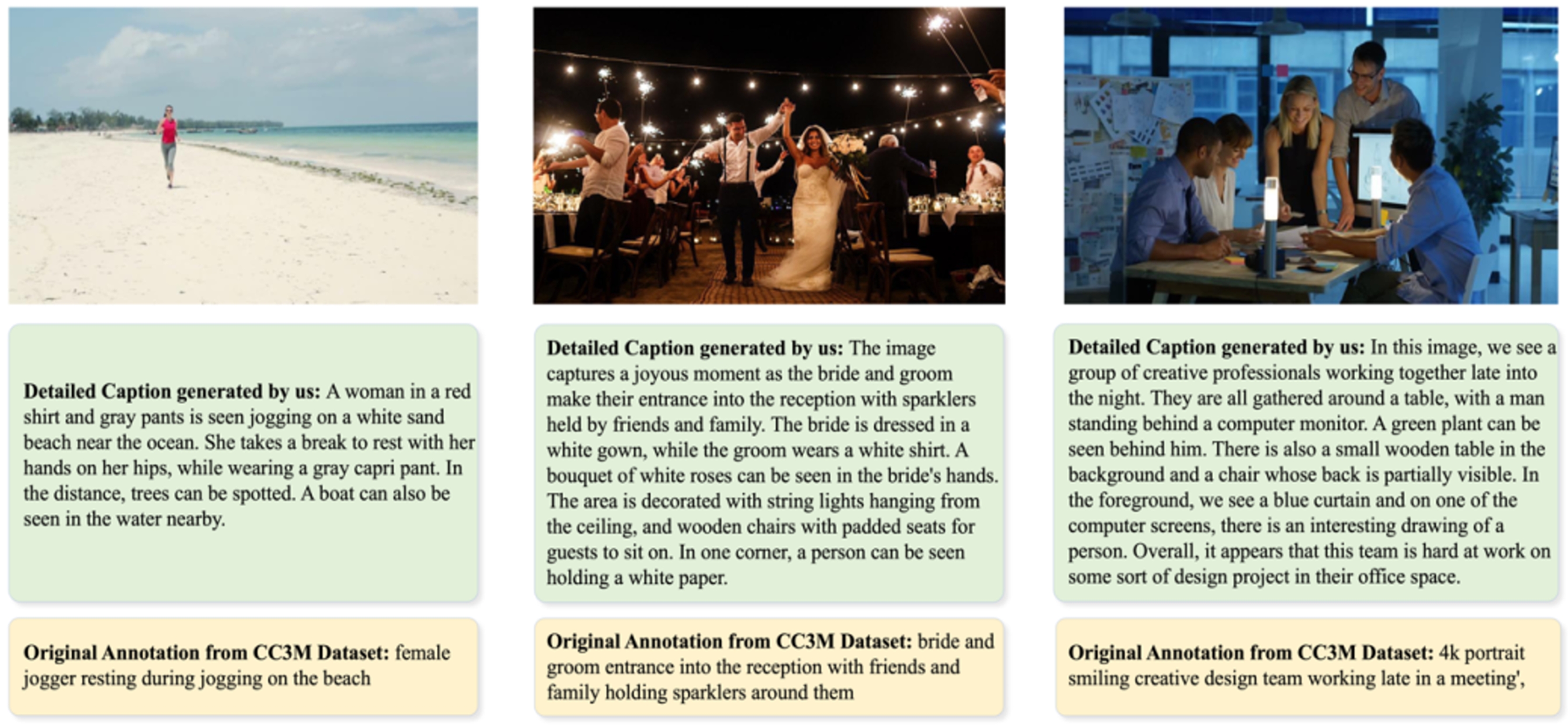
The data from our multi-level description generation method is now open-sourced and available for download at [Link](https://huggingface.co/datasets/echo840/Detailed_Caption). We already upload the images used in multi-level description. Examples:
You can download train images of Monkey from [Train](https://pan.baidu.com/s/1svSjXTxWpI-3boALgSeLlw). Extraction code: 4hdh
You can download test images and jsonls of Monkey from [Test](https://pan.baidu.com/s/1ABrQKeE9QBeKvtGzXfM8Eg). Extraction code: 5h71
The images are from CC3M, COCO Caption, TextCaps, VQAV2, OKVQA, GQA, ScienceQA, VizWiz, TextVQA, OCRVQA, ESTVQA, STVQA, AI2D and DUE_Benchmark. When using the data, it is necessary to comply with the protocols of the original dataset.
## Evaluate
We offer evaluation code for 14 Visual Question Answering (VQA) datasets in the `evaluate_vqa.py` file, facilitating a quick verification of results. The specific operations are as follows:
1. Make sure you have configured the [environment](#environment).
2. Modify `sys.path.append("pathto/Monkey")` to the project path.
3. Prepare the datasets required for evaluation.
4. Run the evaluation code.
Take ESTVQA as an example:
- Prepare data according to the following directory structure:
```
├── data
| ├── estvqa
| ├── test_image
| ├── {image_path0}
| ├── {image_path1}
| ·
| ·
| ├── estvqa.jsonl
```
- Example of the format of each line of the annotated `.jsonl` file:
```
{"image": "data/estvqa/test_image/011364.jpg", "question": "What is this store?", "answer": "pizzeria", "question_id": 0}
```
- Modify the dictionary `ds_collections`:
```
ds_collections = {
'estvqa_test': {
'test': 'data/estvqa/estvqa.jsonl',
'metric': 'anls',
'max_new_tokens': 100,
},
...
}
```
- Run the following command:
```
bash eval/eval.sh 'EVAL_PTH' 'SAVE_NAME'
```
## Citing Monkey
If you wish to refer to the baseline results published here, please use the following BibTeX entries:
```BibTeX
@inproceedings{li2024monkey,
title={Monkey: Image resolution and text label are important things for large multi-modal models},
author={Li, Zhang and Yang, Biao and Liu, Qiang and Ma, Zhiyin and Zhang, Shuo and Yang, Jingxu and Sun, Yabo and Liu, Yuliang and Bai, Xiang},
booktitle={proceedings of the IEEE/CVF conference on computer vision and pattern recognition},
pages={26763--26773},
year={2024}
}
@article{zhu2024moe,
title={Moe jetpack: From dense checkpoints to adaptive mixture of experts for vision tasks},
author={Zhu, Xingkui and Guan, Yiran and Liang, Dingkang and Chen, Yuchao and Liu, Yuliang and Bai, Xiang},
journal={Advances in Neural Information Processing Systems},
volume={37},
pages={12094--12118},
year={2024}
}
@article{liu2024textmonkey,
title={TextMonkey: An OCR-Free Large Multimodal Model for Understanding Document},
author={Liu, Yuliang and Yang, Biao and Liu, Qiang and Li, Zhang and Ma, Zhiyin and Zhang, Shuo and Bai, Xiang},
journal={IEEE transactions on pattern analysis and machine intelligence},
year={2026}
}
@article{huang2024mini,
title={Mini-Monkey: Multi-Scale Adaptive Cropping for Multimodal Large Language Models},
author={Huang, Mingxin and Liu, Yuliang and Liang, Dingkang and Jin, Lianwen and Bai, Xiang},
journal={International Conference on Learning Representations},
year={2024}
}
@article{deng2024r,
title={R-CoT: Reverse Chain-of-Thought Problem Generation for Geometric Reasoning in Large Multimodal Models},
author={Deng, Linger and Liu, Yuliang and Li, Bohan and Luo, Dongliang and Wu, Liang and Zhang, Chengquan and Lyu, Pengyuan and Zhang, Ziyang and Zhang, Gang and Ding, Errui and others},
journal={Conference on Empirical Methods in Natural Language Processing},
year={2024}
}
@article{wu2026liquid,
title={Liquid: Language models are scalable and unified multi-modal generators},
author={Wu, Junfeng and Jiang, Yi and Ma, Chuofan and Liu, Yuliang and Zhao, Hengshuang and Yuan, Zehuan and Bai, Song and Bai, Xiang},
journal={International Journal of Computer Vision},
volume={134},
number={1},
pages={39},
year={2026},
publisher={Springer}
}
@inproceedings{li2025lira,
title={LIRA: Inferring Segmentation in Large Multi-modal Models with Local Interleaved Region Assistance},
author={Li, Zhang and Yang, Biao and Liu, Qiang and Zhang, Shuo and Ma, Zhiyin and Yin, Liang and Deng, Linger and Sun, Yabo and Liu, Yuliang and Bai, Xiang},
booktitle={Proceedings of the IEEE/CVF International Conference on Computer Vision},
pages={24056--24067},
year={2025}
}
@article{li2025monkeyocr,
title={MonkeyOCR: Document Parsing with a Structure-Recognition-Relation Triplet Paradigm},
author={Li, Zhang and Liu, Yuliang and Liu, Qiang and Ma, Zhiyin and Zhang, Ziyang and Zhang, Shuo and Guo, Zidun and Zhang, Jiarui and Wang, Xinyu and Bai, Xiang},
journal={arXiv preprint arXiv:2506.05218},
year={2025}
}
```
## Acknowledgement
The Monkey series is primarily focused on exploring techniques such as image resolution enhancement and token compression methods to improve the performance of existing multimodal large models. For instance, earlier versions of Monkey and TextMonkey were based on QwenVL, while MiniMonkey is based on InternVL2 and miniCPM, among others. Thanks to
[Qwen-VL](https://github.com/QwenLM/Qwen-VL.git), [LLAMA](https://github.com/meta-llama/llama), [LLaVA](https://github.com/haotian-liu/LLaVA), [OpenCompass](https://github.com/open-compass/opencompass), [InternLM](https://github.com/InternLM/InternLM), and [InternVL](https://github.com/OpenGVLab/InternVL).
## Copyright
Monkey project is intended for non-commercial use only. For commercial inquiries or to explore more advanced versions of the Monkey series LMMs (<1b, 2b, 7b, 72b), please contact Prof. Yuliang Liu at ylliu@hust.edu.cn.