# distil-whisper
**Repository Path**: chiyee/distil-whisper
## Basic Information
- **Project Name**: distil-whisper
- **Description**: No description available
- **Primary Language**: Unknown
- **License**: MIT
- **Default Branch**: main
- **Homepage**: None
- **GVP Project**: No
## Statistics
- **Stars**: 1
- **Forks**: 0
- **Created**: 2023-11-08
- **Last Updated**: 2023-11-20
## Categories & Tags
**Categories**: Uncategorized
**Tags**: None
## README
# Distil-Whisper
[[Paper]](https://arxiv.org/abs/2311.00430)
[[Models]](https://huggingface.co/collections/distil-whisper/distil-whisper-models-65411987e6727569748d2eb6)
[[Colab]](https://colab.research.google.com/github/sanchit-gandhi/notebooks/blob/main/Distil_Whisper_Benchmark.ipynb)
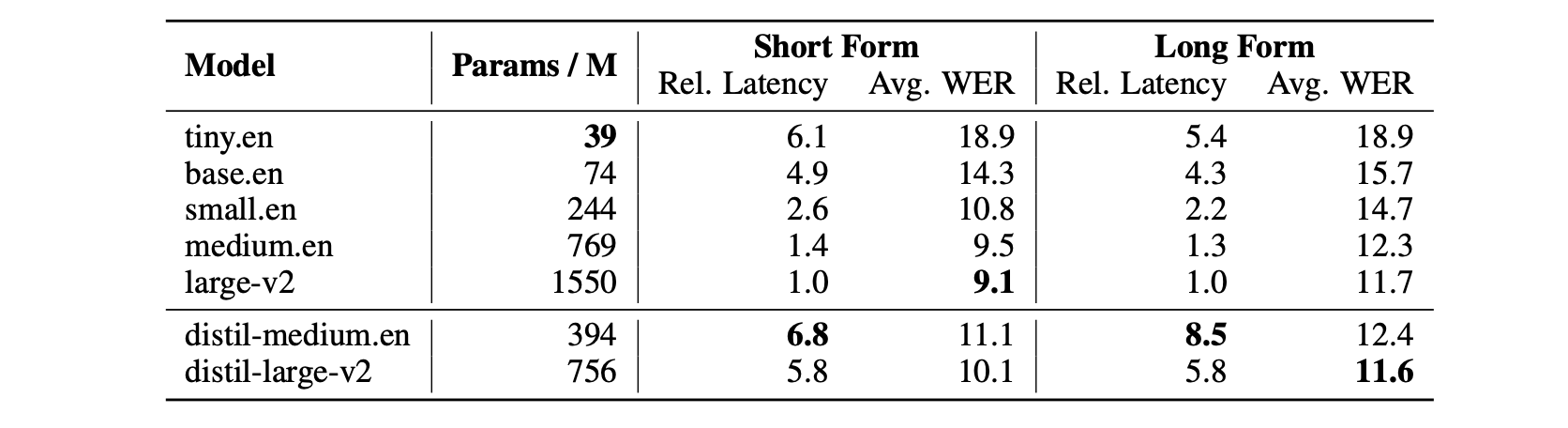
Distil-Whisper is a distilled version of Whisper that is **6 times faster**, 49% smaller, and performs **within 1% word
error rate (WER)** on out-of-distribution evaluation sets.
| Model | Params / M | Rel. Latency | Short-Form WER | Long-Form WER |
|----------------------------------------------------------------------------|------------|--------------|----------------|---------------|
| [whisper-large-v2](https://huggingface.co/openai/whisper-large-v2) | 1550 | 1.0 | **9.1** | 11.7 |
| | | | | |
| [distil-large-v2](https://huggingface.co/distil-whisper/distil-large-v2) | 756 | 5.8 | 10.1 | **11.6** |
| [distil-medium.en](https://huggingface.co/distil-whisper/distil-medium.en) | **394** | **6.8** | 11.1 | 12.4 |
**Note:** Distil-Whisper is currently only available for English speech recognition. Multilingual support will be provided soon.
## 1. Usage
Distil-Whisper is supported in Hugging Face 🤗 Transformers from version 4.35 onwards. To run the model, first
install the latest version of the Transformers library. For this example, we'll also install 🤗 Datasets to load a toy
audio dataset from the Hugging Face Hub:
```bash
pip install --upgrade pip
pip install --upgrade transformers accelerate datasets[audio]
```
### Short-Form Transcription
Short-form transcription is the process of transcribing audio samples that are less than 30-seconds long, which is the
maximum receptive field of the Whisper models. This means the entire audio clip can be processed in one go without the
need for chunking.
First, we load Distil-Whisper via the convenient [`AutoModelForSpeechSeq2Seq`](https://huggingface.co/docs/transformers/model_doc/auto#transformers.AutoModelForSpeechSeq2Seq) and [`AutoProcessor`](https://huggingface.co/docs/transformers/model_doc/auto#transformers.AutoProcessor) classes.
We load the model in `float16` precision and make sure that loading time takes as little time as possible by passing `low_cpu_mem_usage=True`.
In addition, we want to make sure that the model is loaded in [`safetensors`](https://github.com/huggingface/safetensors) format by passing `use_safetensors=True`:
```python
import torch
from transformers import AutoModelForSpeechSeq2Seq, AutoProcessor, pipeline
device = "cuda:0" if torch.cuda.is_available() else "cpu"
torch_dtype = torch.float16 if torch.cuda.is_available() else torch.float32
model_id = "distil-whisper/distil-large-v2"
model = AutoModelForSpeechSeq2Seq.from_pretrained(
model_id, torch_dtype=torch_dtype, low_cpu_mem_usage=True, use_safetensors=True
)
model.to(device)
processor = AutoProcessor.from_pretrained(model_id)
```
The model and processor can then be passed to the [`pipeline`](https://huggingface.co/docs/transformers/main_classes/pipelines#transformers.AutomaticSpeechRecognitionPipeline).
Note that if you would like to have more control over the generation process, you can directly make use of `model.generate(...)` as shown [here](https://huggingface.co/docs/transformers/v4.34.1/en/model_doc/whisper#transformers.WhisperForConditionalGeneration.forward.example).
```python
pipe = pipeline(
"automatic-speech-recognition",
model=model,
tokenizer=processor.tokenizer,
feature_extractor=processor.feature_extractor,
max_new_tokens=128,
torch_dtype=torch_dtype,
device=device,
)
```
Next, we load an example short-form audio from the LibriSpeech corpus:
```python
from datasets import load_dataset
dataset = load_dataset("hf-internal-testing/librispeech_asr_dummy", "clean", split="validation")
sample = dataset[0]["audio"]
```
Finally, we can call the pipeline to transcribe the audio:
```python
result = pipe(sample)
print(result["text"])
```
To transcribe a local audio file, simply pass the path to your audio file when you call the pipeline:
```python
result = pipe("audio.mp3")
print(result["text"])
```
For more information on how to customize the automatic speech recognition pipeline, please refer to the ASR pipeline [docs](https://huggingface.co/docs/transformers/v4.34.1/en/main_classes/pipelines#transformers.AutomaticSpeechRecognitionPipeline).
We also provide an end-to-end [Google Colab](https://colab.research.google.com/github/sanchit-gandhi/notebooks/blob/main/Distil_Whisper_Benchmark.ipynb) that benchmarks Whisper against Distil-Whisper.
### Long-Form Transcription
Distil-Whisper uses a chunked algorithm to transcribe long-form audio files longer than 30-seconds. In practice, this
chunked long-form algorithm is 9x faster than the sequential algorithm proposed by OpenAI in the Whisper paper
(see Table 7 of the [Distil-Whisper paper](https://arxiv.org/abs/2311.00430)).
We can load the model and processor as before:
```python
import torch
from transformers import AutoModelForSpeechSeq2Seq, AutoProcessor, pipeline
device = "cuda:0" if torch.cuda.is_available() else "cpu"
torch_dtype = torch.float16 if torch.cuda.is_available() else torch.float32
model_id = "distil-whisper/distil-large-v2"
model = AutoModelForSpeechSeq2Seq.from_pretrained(
model_id, torch_dtype=torch_dtype, low_cpu_mem_usage=True, use_safetensors=True
)
model.to(device)
processor = AutoProcessor.from_pretrained(model_id)
```
To enable chunking, pass the `chunk_length_s` parameter to the `pipeline`. For Distil-Whisper, a chunk length of 15-seconds
is optimal. To activate batching, pass the argument `batch_size`:
```python
pipe = pipeline(
"automatic-speech-recognition",
model=model,
tokenizer=processor.tokenizer,
feature_extractor=processor.feature_extractor,
max_new_tokens=128,
chunk_length_s=15,
batch_size=16,
torch_dtype=torch_dtype,
device=device,
)
```
The argument `max_new_tokens` controls the maximum number of generated tokens *per-chunk*. In the typical speech setting,
we have no more than 3 words spoken per-second. Therefore, for a 15-second input, we have at most 45 words (approx 60 tokens).
We set the maximum number of generated tokens per-chunk to 128 to truncate any possible hallucinations that occur at the
end of the segment. These tokens get removed at the chunk borders using the long-form chunking transcription algorithm,
so it is more efficient to truncate them directly during generation to avoid redundant generation steps in the decoder.
Now, let's load a long-form audio sample. Here, we use an example of concatenated samples from the LibriSpeech corpus:
```python
from datasets import load_dataset
dataset = load_dataset("distil-whisper/librispeech_long", "clean", split="validation")
sample = dataset[0]["audio"]
```
Finally, we can call the pipeline to transcribe the audio:
```python
result = pipe(sample)
print(result["text"])
```
For more information on how to customize the automatic speech recognition pipeline, please refer to the ASR pipeline [docs](https://huggingface.co/docs/transformers/v4.34.1/en/main_classes/pipelines#transformers.AutomaticSpeechRecognitionPipeline).
### Speculative Decoding
Distil-Whisper can be used as an assistant model to Whisper for speculative decoding. As a refresher, we recommend reading Joao's [amazing blog post](https://huggingface.co/blog/assisted-generation) or taking a look at [the original paper](https://arxiv.org/abs/2211.17192).
Speculative decoding mathematically ensures the exact same outputs as Whisper are obtained while being 2 times faster.
This makes it the perfect drop-in replacement for existing Whisper pipelines, since the same outputs are guaranteed.
For speculative decoding, we need to load both the teacher: [`openai/whisper-large-v2`](https://huggingface.co/openai/whisper-large-v2).
As well as the assistant (*a.k.a* student) [`distil-whisper/distil-large-v2`](https://huggingface.co/distil-whisper/distil-large-v2).
Let's start by loading the teacher model and processor. We do this in much the same way we loaded the Distil-Whisper
model in the previous examples:
```python
from transformers import AutoModelForSpeechSeq2Seq, AutoProcessor
import torch
device = "cuda:0" if torch.cuda.is_available() else "cpu"
torch_dtype = torch.float16 if torch.cuda.is_available() else torch.float32
model_id = "openai/whisper-large-v2"
model = AutoModelForSpeechSeq2Seq.from_pretrained(
model_id, torch_dtype=torch_dtype, low_cpu_mem_usage=True, use_safetensors=True
)
model.to(device)
processor = AutoProcessor.from_pretrained(model_id)
```
Now let's load the assistant. Since Distil-Whisper shares exactly same encoder as the teacher model, we only need
to load the 2-layer decoder as a "Decoder-only" model:
```python
from transformers import AutoModelForCausalLM
assistant_model_id = "distil-whisper/distil-large-v2"
assistant_model = AutoModelForCausalLM.from_pretrained(
assistant_model_id, torch_dtype=torch_dtype, low_cpu_mem_usage=True, use_safetensors=True
)
assistant_model.to(device)
```
The assistant model shares the same processor as the teacher, so there's no need to load a student processor.
We can now pass the assistant model to the pipeline to be used for speculative decoding. We pass it as a `generate_kwarg`
with the key [`"assistant_model"`](https://huggingface.co/docs/transformers/main/en/main_classes/text_generation#transformers.GenerationMixin.generate.assistant_model)
so that speculative decoding is enabled:
```python
pipe = pipeline(
"automatic-speech-recognition",
model=model,
tokenizer=processor.tokenizer,
feature_extractor=processor.feature_extractor,
max_new_tokens=128,
generate_kwargs={"assistant_model": assistant_model},
torch_dtype=torch_dtype,
device=device,
)
```
As before, we can pass any sample to the pipeline to be transcribed:
```python
from datasets import load_dataset
dataset = load_dataset("hf-internal-testing/librispeech_asr_dummy", "clean", split="validation")
sample = dataset[0]["audio"]
result = pipe(sample)
print(result["text"])
```
**Note:** speculative decoding should be on average 2x faster than using "only" Whisper large-v2 at a mere 8% increase
in VRAM memory usage while mathematically ensuring the same results. This makes it the perfect replacement for Whisper large-v2
in existing speech recognition pipelines.
### Additional Speed & Memory Improvements
You can apply additional speed and memory improvements to Distil-Whisper which we cover in the following.
#### Flash Attention
We recommend using [Flash Attention 2](https://huggingface.co/docs/transformers/main/en/perf_infer_gpu_one#flashattention-2) if your GPU allows for it.
To do so, you first need to install [Flash Attention](https://github.com/Dao-AILab/flash-attention):
```
pip install flash-attn --no-build-isolation
```
You can then pass `use_flash_attention_2=True` to `from_pretrained` to enable Flash Attention 2:
```diff
- model = AutoModelForSpeechSeq2Seq.from_pretrained(model_id, torch_dtype=torch_dtype, low_cpu_mem_usage=True, use_safetensors=True)
+ model = AutoModelForSpeechSeq2Seq.from_pretrained(model_id, torch_dtype=torch_dtype, low_cpu_mem_usage=True, use_safetensors=True, use_flash_attention_2=True)
```
#### Torch Scale-Product-Attention (SDPA)
If your GPU does not support Flash Attention, we recommend making use of [BetterTransformers](https://huggingface.co/docs/transformers/main/en/perf_infer_gpu_one#bettertransformer).
To do so, you first need to install optimum:
```
pip install --upgrade optimum
```
And then convert your model to a "BetterTransformer" model before using it:
```diff
model = AutoModelForSpeechSeq2Seq.from_pretrained(model_id, torch_dtype=torch_dtype, low_cpu_mem_usage=True, use_safetensors=True)
+ model = model.to_bettertransformer()
```
## 2. Why use Distil-Whisper? ⁉️
Distil-Whisper is designed to be a drop-in replacement for Whisper on English speech recognition. Here are 5 reasons for making the
switch to Distil-Whisper:
1. **Faster inference:** 6 times faster inference speed, while performing to within 1% WER of Whisper on out-of-distribution audio:
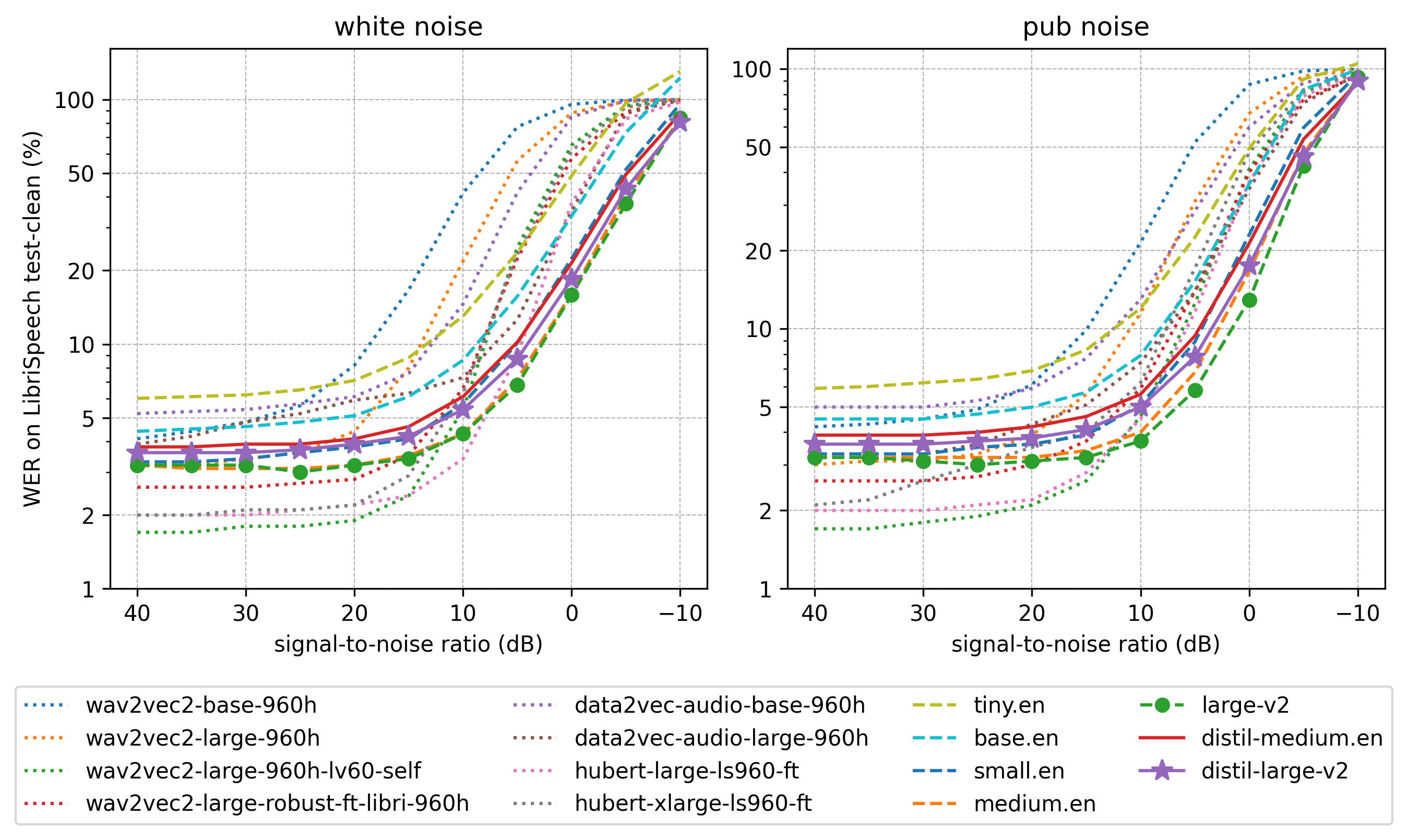
2. **Robustness to noise:** demonstrated by strong WER performance at low signal-to-noise ratios:
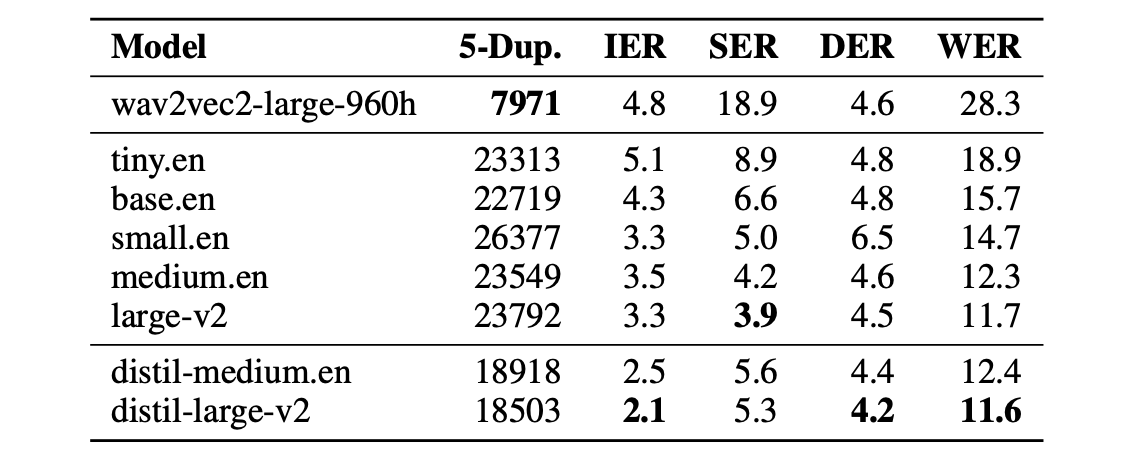
3. **Robustness to hallucinations:** quantified by 1.3 times fewer repeated 5-gram word duplicates (5-Dup.) and 2.1% lower insertion error rate (IER) than Whisper:
4. **Designed for speculative decoding:** Distil-Whisper can be used as an assistant model to Whisper, giving 2 times faster inference speed while mathematically ensuring the same outputs as the Whisper model.
5. **Permissive license:** Distil-Whisper is [MIT licensed](./LICENSE), meaning it can be used for commercial applications.
## 3. Approach ✍️
To distill Whisper, we copy the entire encoder module and freeze it during training. We copy only two decoder layers,
which are initialised from the first and last decoder layers from Whisper. All other decoder layers from Whisper
are discarded:
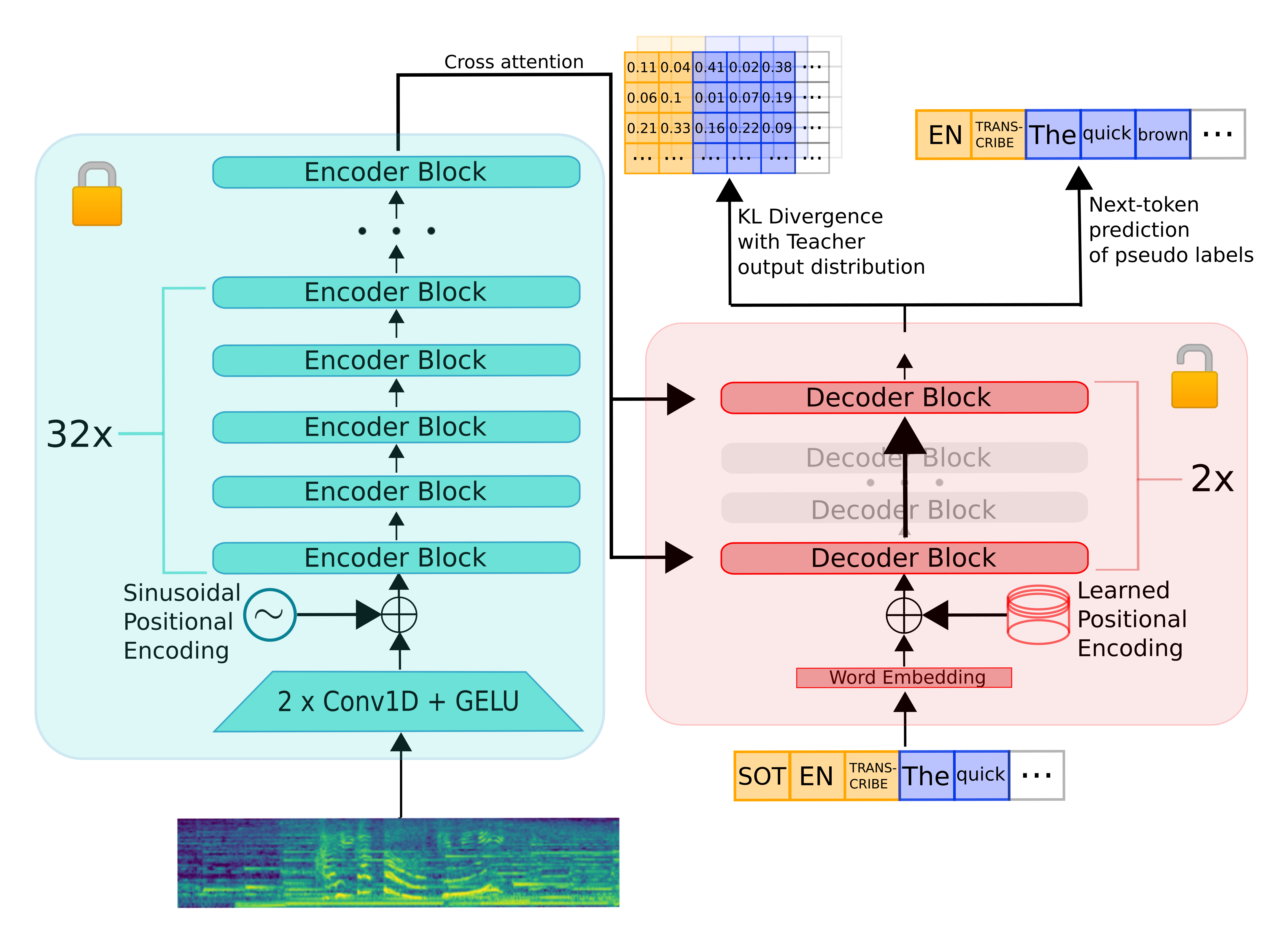
Distil-Whisper is trained on a *knowledge distillation* objective. Specifically, it is trained to minimise the KL divergence
between the distilled model and the Whisper model, as well as the cross-entropy loss on pseudo-labelled audio data.
We train Distil-Whisper on a total of 22k hours of pseudo-labelled audio data, spanning 10 domains with over 18k speakers:
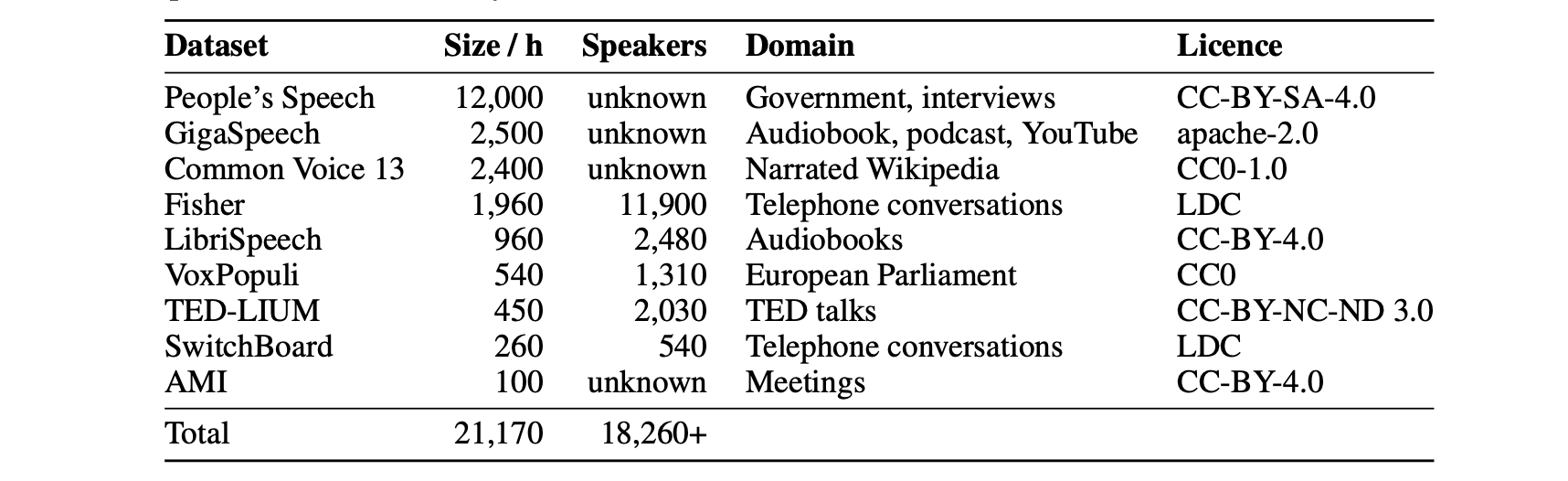
This diverse audio dataset is paramount to ensuring robustness of Distil-Whisper to different datasets and domains.
In addition, we use a WER filter to discard pseudo-labels where Whisper mis-transcribes or hallucinates. This greatly
improves WER performance of the downstream distilled model.
For full details on the distillation set-up and evaluation results, refer to the [Distil-Whisper paper](https://arxiv.org/abs/2311.00430).
## 4. Training Code
Training code to reproduce Distil-Whisper will be published here shortly. We will also release more general code to distill
Whisper for multilingual speech recognition, facilitating anyone in the community to distill Whisper on their choice of
language.
## 5. Acknowledgements
* OpenAI for the Whisper [model](https://huggingface.co/openai/whisper-large-v2) and [original codebase](https://github.com/openai/whisper)
* Hugging Face 🤗 [Transformers](https://github.com/huggingface/transformers) for the model integration
* Google's [TPU Research Cloud (TRC)](https://sites.research.google/trc/about/) program for Cloud TPU v4s
## 6. Citation
If you use this model, please consider citing the Distil-Whisper paper:
```
@misc{gandhi2023distilwhisper,
title={Distil-Whisper: Robust Knowledge Distillation via Large-Scale Pseudo Labelling},
author={Sanchit Gandhi and Patrick von Platen and Alexander M. Rush},
year={2023},
eprint={2311.00430},
archivePrefix={arXiv},
primaryClass={cs.CL}
}
```
And also the Whisper paper:
```
@misc{radford2022robust,
title={Robust Speech Recognition via Large-Scale Weak Supervision},
author={Alec Radford and Jong Wook Kim and Tao Xu and Greg Brockman and Christine McLeavey and Ilya Sutskever},
year={2022},
eprint={2212.04356},
archivePrefix={arXiv},
primaryClass={eess.AS}
}
```